Upright vs Recumbent vs Spin vs Air Bikes: Which Commercial Bike Fits Your Project?
Compare upright, recumbent, spin and air bikes by user profile, footprint, resistance, maintenance and commercial application.
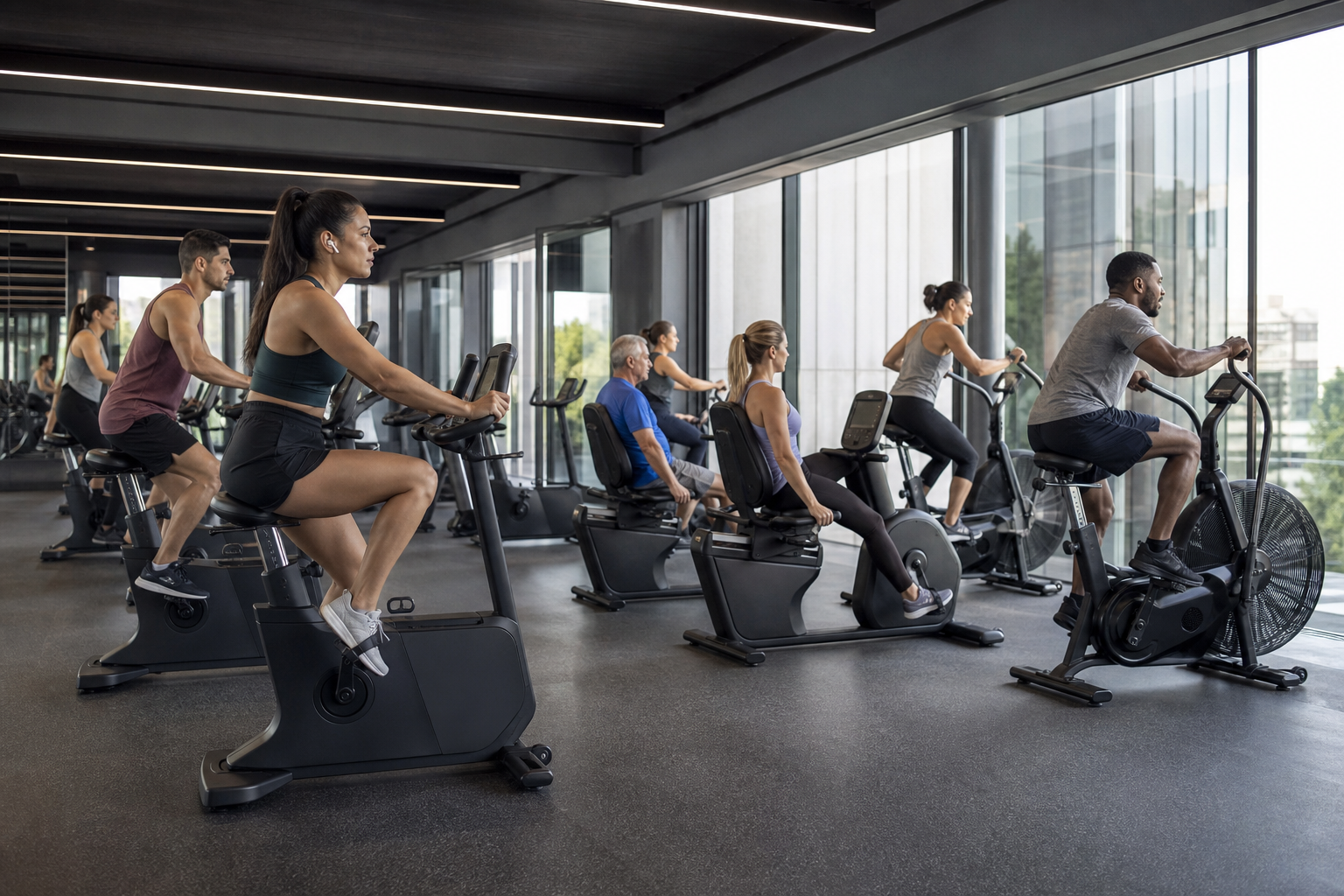
Upright, recumbent, spin and air bikes serve different commercial roles. Select the format from the users, available floor space, training purpose, resistance system and maintenance plan; a balanced facility often combines more than one type instead of treating every bike as interchangeable.
Buying commercial cardio equipment is a project decision, not just a product comparison. This guide organizes the practical questions that help owners, distributors, contractors and procurement teams create a more useful brief.
The bike type changes the user experience
Commercial exercise bikes are not interchangeable. Upright bikes support a familiar seated cycling position with a relatively compact footprint. Recumbent bikes place the user in a supported position with a backrest and are often easier to approach for users who prefer lower-impact or more stable training. Spin bikes emphasize cycling posture, flywheel feel and instructor-led or performance-oriented sessions. Air bikes use fan resistance and commonly involve both the arms and legs.
For procurement, the important question is not which bike is universally best. It is which movement, posture and control system fits the people who will use the room. A hotel may need a small number of intuitive formats. A performance studio may prioritize spin bikes. A rehabilitation or senior-focused room may value access, support and an easy-to-understand resistance response.
A mixed cardio floor often benefits from more than one bike type. Combining upright and recumbent formats can serve different user preferences, while a smaller number of spin or air bikes can support specialized training without taking over the whole room.
Upright bikes: compact and familiar
Upright bikes are a practical core product for many commercial facilities. They are recognizable, easy to place in a row and useful for steady-state cardio, warm-ups and general fitness. Buyers should compare seat adjustment, handlebar position, pedal design, resistance control, console visibility and the space needed for users to enter and exit.
For a distributor, upright bikes can be a strong range anchor because they fit multiple applications. The model still needs a clear commercial specification: frame stability, resistance levels, display information, power approach, dimensions, packaging and available branding. Ask how the bike is checked before shipment and what wear parts are expected over time.
Upright bikes should be positioned where users can move around them safely and where the operator can clean and service the contact areas. A compact footprint helps, but the final layout must include access rather than only the machine width.
Recumbent bikes: support and accessibility
Recumbent bikes use a back-supported seated position. That design can be useful for users who prefer more trunk support, for lower-impact programming or for facilities that want to offer a different entry point into cardio training. A step-through frame, adjustable seat and clear hand positions can make a meaningful difference to usability.
The trade-off is space. The backrest and longer frame can increase the footprint, so a recumbent bike should be planned with approach space and service access. Buyers should review the seat travel, pedal reach, user-weight guidance, display angle, resistance system and cleaning points.
For hotels, apartment gyms and rehabilitation-oriented projects, recumbents can help make the cardio area feel more inclusive. The manufacturer should still confirm the intended use and any local requirements rather than making medical claims that the product documentation does not support.
Tell us the facility type, destination, quantity and intended user profile. We can organize an upright, recumbent, spin or air bike shortlist around the project.
Spin bikes and air bikes: specialized conditioning
Spin bikes are designed around a cycling-specific training experience. Compare flywheel behavior, resistance adjustment, emergency stop or brake method, saddle and handlebar adjustment, pedal system and console needs. The correct model depends on whether the bike will be used in a studio, on a general cardio floor or in a performance area.
Air bikes create resistance through a fan and often coordinate arm and leg movement. They can be useful for conditioning zones and high-intensity programming. Buyers should review fan size, frame stability, handle movement, seat adjustment, display, noise expectations and how the unit will be used during repeated intervals.
These products are not simply alternatives to an upright bike. They fill a different programming role. A clear quotation should show that difference so a facility owner can compare the equipment mix by training purpose rather than by unit price alone.
Compare resistance, console and service together
Resistance type shapes how the user changes effort and how the operator maintains the product. Magnetic systems may offer a controlled feel and low routine noise; air systems respond to user effort and airflow; other systems may be selected for a specific commercial configuration. Ask for the exact resistance description and adjustment range for each model.
Review the console as part of the workflow. The screen should show useful information clearly, while buttons or adjustment controls should be easy to understand. For OEM orders, confirm language, logo placement, color, startup screen and packaging artwork before production. Do not assume that a visual change also changes the underlying software or electrical configuration.
Service planning should cover pedals, straps, seats, adjustment rails, bearings, flywheels, fans, cables, displays and power components as applicable. Ask what the factory recommends for cleaning, inspection and spare-parts planning in the destination market.
A decision framework for procurement teams
Use five filters. First, user profile: who needs support, performance training or a familiar general-purpose movement? Second, facility role: general cardio, studio, hotel, apartment, corporate, rehabilitation or conditioning zone? Third, space: what footprint and approach area can the floor accommodate? Fourth, service: what can the local team inspect and replace? Fifth, range strategy: how should the bike complement treadmills, ellipticals, climbers and rowers?
Put each bike format into a simple comparison sheet with the model, movement, resistance, adjustment, console, dimensions, weight, packaging, warranty and customization fields. Add a column for confirmed, pending or not applicable. This small discipline prevents an attractive product photo from hiding an unresolved project requirement.
When the project becomes specific, send the supplier the destination, quantity by type, room dimensions, preferred console, branding requirements, target delivery and service expectations. A factory-integrated supplier can then respond with a more useful mix and identify what needs confirmation before production.
Visual Content Plan
Use real factory and product photography where available. The following briefs are ready for an AI image workflow or a photographer's shot list; keep the final images factual and consistent with the actual equipment.
Introduce bike-format comparison
Caption: Different commercial bike formats serve different training roles.
ALT: Upright and recumbent commercial exercise bikes
Prompt: Photorealistic commercial cardio showroom displaying upright, recumbent, spin and air bikes in a clean organized arrangement, premium B2B fitness equipment photography, no readable text
Explain supported positioning
Caption: A supported seating position changes access and space planning.
ALT: Commercial recumbent exercise bike with backrest
Prompt: High-detail product photograph of a commercial recumbent exercise bike with adjustable backrest in a bright fitness facility, realistic industrial design, no visible brand text
Show factory quality checks
Caption: Bike assemblies should be checked before shipment.
ALT: Factory worker checking a commercial exercise bike
Prompt: Documentary-style Chinese cardio equipment factory worker inspecting an exercise bike pedal, seat rail and console, clean production environment, realistic, no fake certificates
Show application fit
Caption: A balanced hotel cardio room can serve different guest preferences.
ALT: Commercial exercise bikes in a hotel fitness room
Prompt: Realistic boutique hotel fitness room with upright and recumbent commercial exercise bikes, clear circulation, warm architectural light, no people, no brand text
Frequently Asked Questions
What is the difference between an upright and recumbent commercial bike?
An upright bike uses a more vertical cycling position and usually a smaller footprint. A recumbent bike uses a back-supported position and generally needs more approach space.
Are spin bikes suitable for a general commercial gym?
They can be, but their value depends on the facility's programming and user demand. Review adjustment, resistance, braking, maintenance and whether the bike will be used in a studio or open cardio area.
What is a commercial air bike used for?
Air bikes are commonly used for conditioning and interval training, with fan resistance that responds to user effort. Confirm the model's intended use, stability, display and noise expectations.
How many bike types should a hotel gym carry?
Start with room size, guest profile and the broader cardio mix. A compact hotel gym may need a small balanced selection rather than every bike format.
Make the next step specific.
A strong commercial cardio decision combines product fit, facility conditions, shipment planning and after-sales clarity. Use this guide to prepare the brief, then confirm the model-level details with the factory before placing an order.
Request Product InformationWhich exercise bike fits your facility?
Share your user profile, space and target quantity for a practical product comparison.
Trigger: Show at 40% scroll, or use exit intent after the comparison table
Fields: Name, Email, Phone, Country, Facility Type, Bike Types Needed, Project Notes
Button: Request My Comparison
Choose the bike mix with the whole floor in view.
Request current specifications, OEM options, packing information and a factory-direct quotation for your commercial cardio project.
Request Product Information